Power reserve is how long a mechanical watch keeps running after it stops being wound. It is given in hours — 38, 42, 70, 120 — and it describes one thing precisely: the time between a fully wound mainspring and a watch that has stopped. It belongs only to mechanical movements. A quartz watch has battery life instead, measured in years.
- Fully woundThe mainspring is at its tightest and holds the whole reserve.
- Running downThe spring gives up its energy at an even rate while the watch runs.
- StoppedToo little force is left to keep the balance swinging.
Where the Energy Sits
Inside the movement, a coiled steel ribbon called the mainspring lives in a barrel. Winding tightens it; the barrel then turns slowly as the spring relaxes and drives the gear train. The length of that spring, the room in the barrel and how efficiently the movement uses the energy together decide the power reserve. Longer reserves usually mean a longer spring, a larger barrel, or two barrels working in series.
How the spring is wound depends on the movement. An automatic winds itself from your wrist as you wear it; a hand-wound movement is filled at the crown, usually once a day. Either way the reserve figure is the same measurement: a full spring, then time.
What the Numbers Mean in Practice
- 38–42 h: a day off the wrist
- 60–70 h: a long weekend
- 72 h and up: Friday to Monday
- 120 h and up: a week, with two barrels
The figure most people feel is 72 hours. Take the watch off on Friday evening and a 42-hour movement has stopped by Sunday morning, while a 72-hour one is still running on Monday, with the date and the time still right. That is the whole practical argument for a long reserve: fewer resets.
What Shortens the Reserve
- Running complications: a chronograph left running, or an alarm, draws from the same spring.
- A movement that is overdue for service: thickened oil and worn pivots cost hours.
- Magnetism: a magnetised hairspring changes the rate and can shorten the running time.
- Cold: low temperatures stiffen the lubricants, so the watch gives up sooner.
- A partly wound spring: most of the quoted figure assumes it was filled completely.
The Power Reserve Indicator
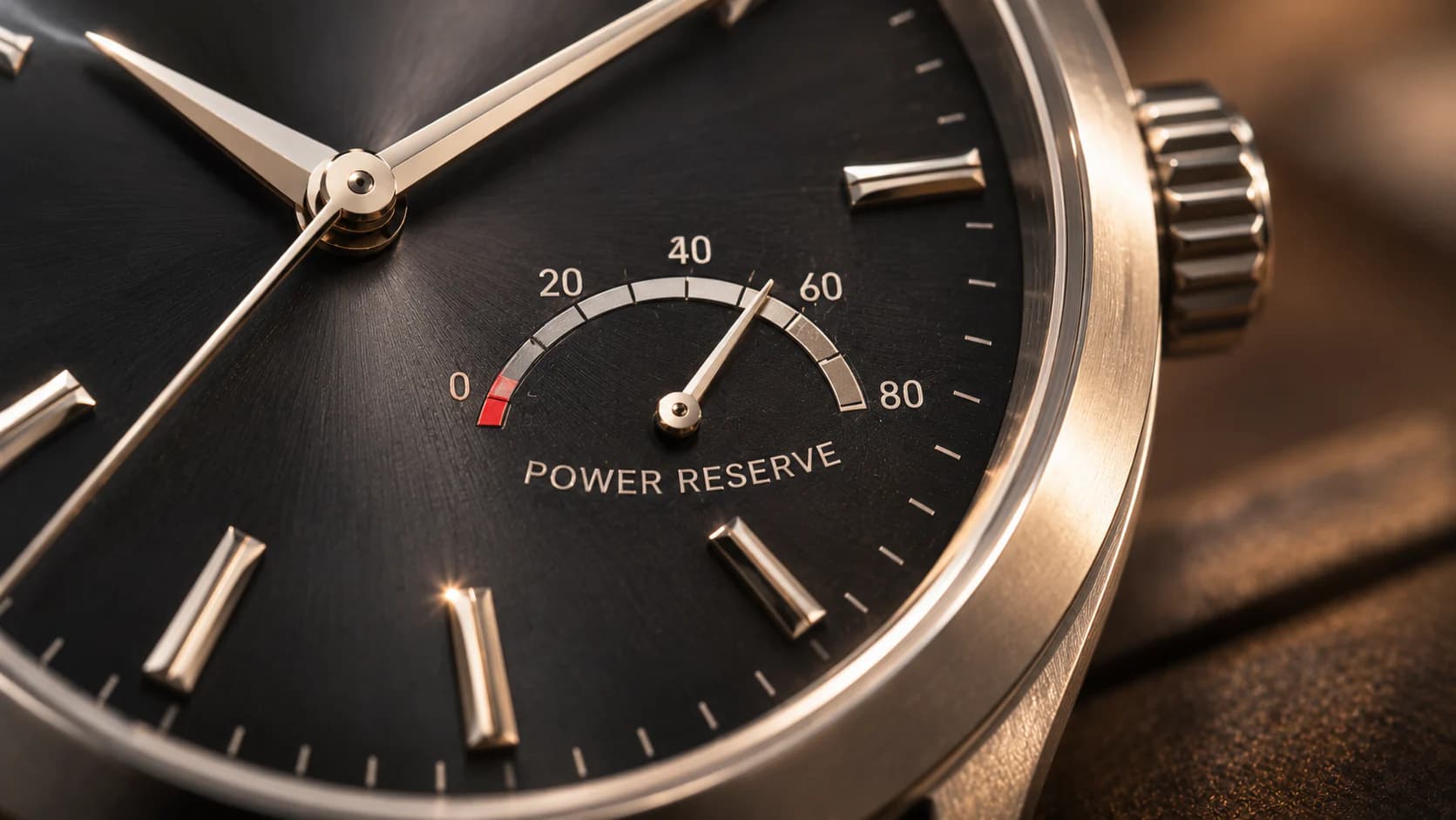
Some watches show what is left on a small dial or an arc on the face, driven by the barrel's own rotation. It is useful on a hand-wound watch, where it tells you when to wind, and on a watch you take off for days at a time. It is a display, not a separate reserve: the hours come from the same mainspring.
On TimeSpecs, a power reserve is shown only when the catalog carries a certain value for the model. Where it is unknown, the specification is left out rather than estimated from the movement type.