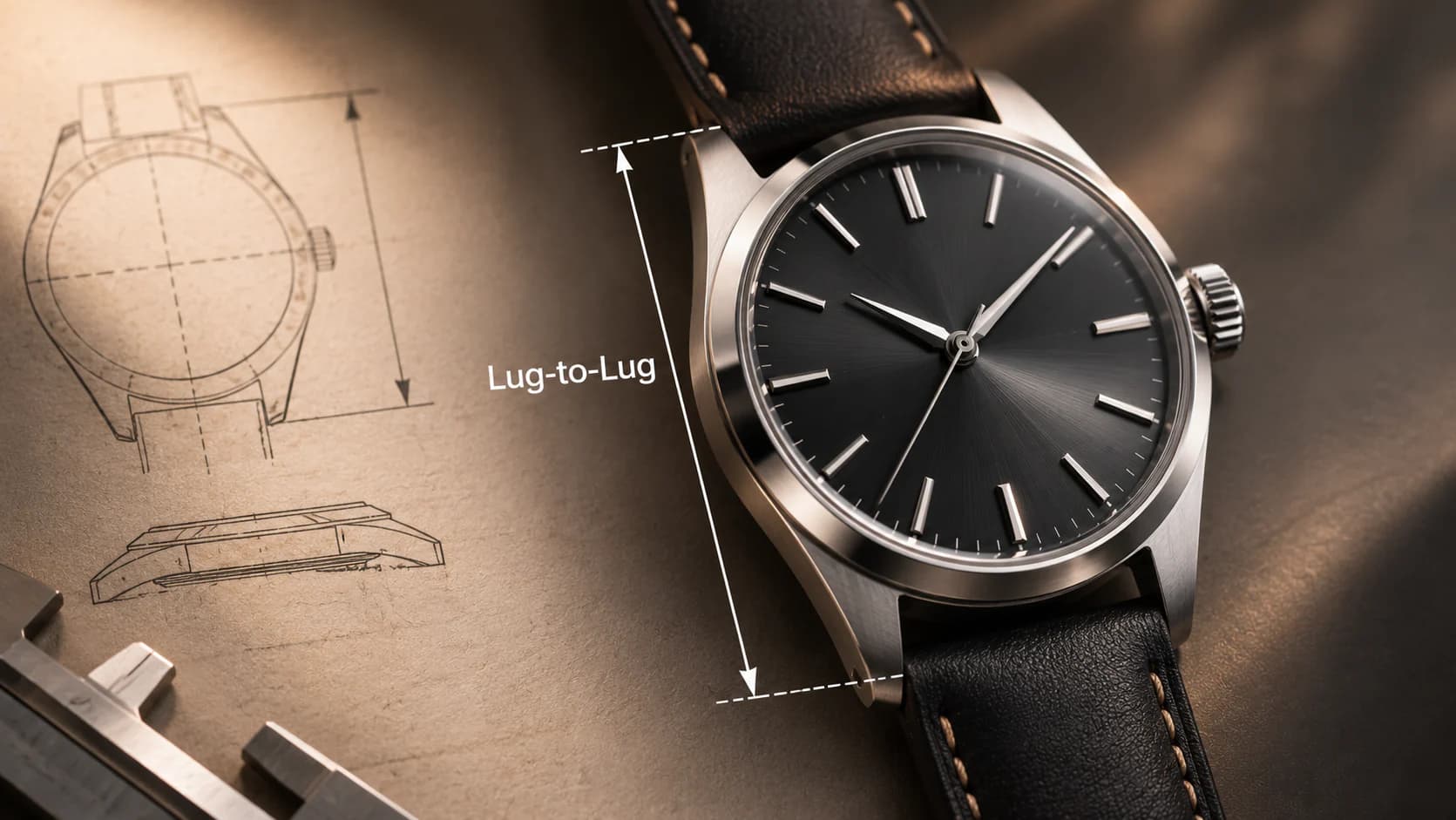
Two watches of the same diameter can sit completely differently on the same wrist. The measurement that explains why is lug-to-lug: the distance from the tip of the upper lug to the tip of the lower one, straight through the dial from 12 to 6 o'clock. Diameter tells you how wide the case looks; lug-to-lug tells you how much of your wrist the watch needs.
- Case diameterAcross the case at its widest, not counting the crown.
- Lug-to-lugFrom the tip of one lug to the tip of the other, through 12 and 6.
- Case thicknessFrom the back of the case to the top of the crystal.
What Lug-to-Lug Measures
The lugs are the four horns the strap or bracelet attaches to. Lug-to-lug is the total length of the case including them, along the axis of your arm. It is the footprint the watch needs on the flat top of your wrist, which is the part that actually carries it.
That is why a 40 mm diver with long, straight lugs can wear larger than a 42 mm dress watch whose lugs curve sharply down. The dial looks smaller on the first and bigger on the second, but the watch that overhangs is the one with the longer lug-to-lug.
Why It Matters More Than Diameter
- Shows the real footprint
- Predicts overhang
- Keeps the strap flat
- Comparable across shapes
When the lug tips run past the flat part of your wrist, the strap leaves the case at an angle, the watch rocks as you move, and the lugs press into the skin on either side. Nothing about the diameter warns you: the case can be modest and still too long. A watch whose lug-to-lug fits sits still, and the strap falls away cleanly on both sides.
How to Measure Your Wrist
- Rest your forearm flat and find the flat top of your wrist, between the two bones.
- Measure that flat part across, from one bony edge to the other, with a ruler. This is the length you are matching.
- Also take the circumference with a tape measure or a strip of paper: it is what strap lengths are given in.
- Keep the arm relaxed. A tensed wrist reads a few millimetres wider than it wears.
| Wrist circumference | Lug-to-lug that usually sits well |
|---|---|
| 14–16 cm | up to about 44 mm |
| 16–17 cm | about 44–48 mm |
| 17–19 cm | about 48–52 mm |
| 19 cm and over | 52 mm and over is wearable |
What Else Changes the Fit
- Case thickness: a thick case raises the centre of gravity and makes the watch rock more easily.
- The curve of the lugs: sharply curved lugs can carry a long case that straight lugs could not.
- The bracelet or strap: a well-articulated bracelet follows the wrist from the first link; a stiff one adds to the length.
- The bezel and the dial opening: a wide bezel makes a watch look smaller than its diameter, and a thin one larger.
On TimeSpecs, a case measurement is shown only when the catalog has a certain value for it. Where a model's lug-to-lug is not known, the specification simply does not appear — it is never estimated from the diameter.